In BC, an architect is registered with AIBC and a home designer isn't. That one fact decides what the law lets each of them do and can impact what stands behind their work. For a lot of houses, a good designer is a fine choice. the difference becomes critical when a change in design or other unexpected challenges come up, and your building suddenly tips into the category of “requiring a registered professional”. this article unpacks some of the nuance around the scope of service each provider can offer.

What each one brings
Home designers draw layouts and plans for residential projects, and many do it well. Architects do that too, with formal training in building science, structural systems, and code. They're registered with AIBC, which sets a minimum scope of architectural service and holds them to professional standards. Designers aren't regulated the way architects are: there's no AIBC-style registration behind the title, no regulator-set minimum scope of service, and no regulator with the power to discipline.
A degree in architecture isn't the same as being an architect
In BC, only someone registered with AIBC can use the title, and only a registered architect can provide design services for the buildings the regulation reserves to architects. Someone can hold an architecture diploma or degree, and design good houses, without being registered. Check the AIBC register before you sign, and ask what happens to the scope and the fee if your project turns out to need an architect later.
Where you feel the difference
Lets look at some examples of projects in the kootenays and Vancouver, and see where in the process having an architect on board is especially useful.
Before the first line is drawn
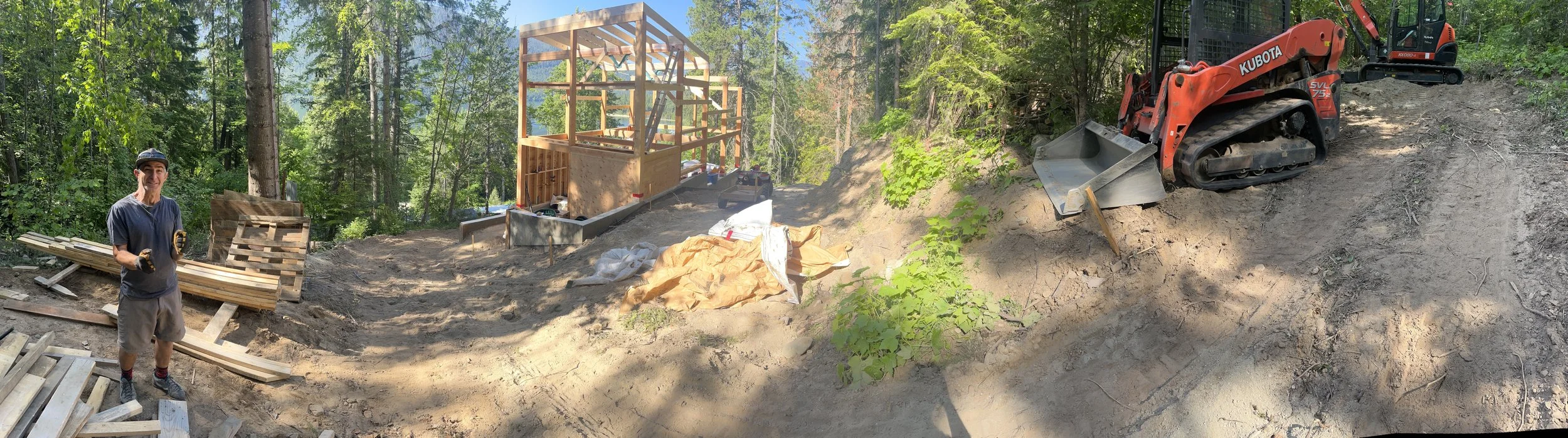
You've bought a steep lot outside Revelstoke or nelson. The City's forms flag slopes over 30% for a geotechnical assessment and a development permit, and they ask about flooding, wildfire, landslides, rockfall, and avalanche. Someone has to read the lot, decide where the house can sit, and line up the specialists. On projects that need registered professionals, an architect can act as the coordinating registered professional, the person who pulls geotechnical, structural, and other engineers into one set of letters of assurance. That's a much easier job when it starts at the first sketch.
At permit review
Revelstoke's permit checklists say a letter of assurance from a registered professional is required when you've retained one, or when the building official decides one is needed during plan review. In BC, a registered professional means an architect or an engineer. If your designer is neither, that's the moment a second professional and a second fee show up, mid-permit, on a timeline you didn't plan for.
When the project scope grows
Add a suite or a second building and the project can cross a size or unit threshold that needs an architect by law: 5 or more dwelling units in a building, a building area over 600 m², 4 or more storeys, or 470 m² for most commercial space. A designer who can't provide an architect has to bring one in at that point, and the fee arrives with them. In Vancouver, where a multiplex can run from three units to six, the number of units and buildings you sketch on day one can decide who's legally allowed to draw it.
When the site and the code disagree
Sometimes the code asks for one thing and the lot makes it impractical or impossible. An architect can develop an alternate solution and take it to the building authority with a registered professional's sign-off, backed by whatever specialist reports the site calls for. Austin has done this many times for slope stability and floodplain. It's the same work as the first moment, applied late, and it goes better when the architect has been on the project from the start.
Questions to ask before you hire anyone
Are you registered with AIBC, and what's your listing on the AIBC register?
If my project turns out to need an architect, who provides that, and what does it cost?
Who would be the coordinating registered professional on my project, and when do they join?
Do you stay through permit and construction, and do you do field review?
Have you taken a code problem to the building authority before? What happened?
A good designer will answer these without trouble. The answers tell you what you're buying.
How it works at f2a
We think of the work the way a backcountry guide does: the project is yours, and you want someone beside you who knows the terrain. At f2a, the architect is on the project from the first sketch. In Revelstoke, our designer Arianna is a local and works closely with principal Austin Hawkins AIBC to take projects from schematic design through to completion.
If you're weighing an architect against a designer for a project in Nelson, Revelstoke, or Vancouver, send us the site and what you have in mind. We'll tell you straight whether it needs an architect.
we’d love to hear about your project. info@f2a.ca